
How much does SEO cost? Most often $500 to $1,000 per month, the most common agency retainer in a 2024 SE Ranking study, though US agencies tend to charge more. Your own price depends on how much work the site needs: technical fixes, new pages, content, and links. At Strymba, SEO starts from $500 per month, and the SEO audit that opens the work is free.
This guide explains what an SEO budget is made of, how the pricing models differ, and how to compare proposals. It’s written for business owners and marketing leads who are choosing an SEO provider or want to know what they’re paying for today.
SEO prices: what the industry data shows
In SE Ranking’s study, 64% of agencies charge under $1,000 per month. Ahrefs reports a higher average, $2,917 per month, calculated from the top end of each price range. The gap comes from the sample and the way each study counts.
| Source | Sample | What it shows |
|---|---|---|
| SE Ranking and Duda, December 2024 | 260 agencies | most common retainer $500–1,000 per month; 64% of agencies charge under $1,000; most common hourly rate $50–100 |
| Ahrefs, updated August 2024 | 439 SEO providers | 78.2% charge a monthly retainer; most popular retainer $501–1,000 per month; average hourly rate $111 |
Location changes the price a lot. According to SE Ranking, 40% of agencies in the US and Canada charge over $125 per hour. In Europe, only 6% do.
Backlinko estimates that US-based SEO services cost three to five times more than those from emerging markets. The same scope can cost very different amounts depending on where your provider is based.
Prices are also rising. In the same SE Ranking survey, 70% of agencies had raised their rates or planned to in 2025. There’s a new budget line too, optimisation for Google’s AI Overviews. Agencies that have set a price for it charge about $937 per month on average.
At Strymba, ongoing SEO starts from $500 per month. We quote the exact figure after a free audit, once we can see the state of the site and the scope of work. First results usually take 3 months or more.
What goes into an SEO budget
Your monthly fee pays for specialists’ time across several streams of work, and the balance shifts over time. Early months lean on technical fixes, and later months on content and links.
| Budget line | What it covers | What drives the effort |
|---|---|---|
| Audit and plan | technical review, demand and competitor research, priorities | site size, number of sections and languages |
| Technical SEO | indexing, speed, duplicates, redirects, structured data | the site’s condition and CMS, who ships the fixes |
| Keywords and structure | search queries, new landing pages, internal links | number of services, categories, and regions |
| Content | page copy and articles, metadata, editing | how many pages and pieces you need each month |
| Authority | mentions and links from other sites, digital PR | competition in your niche |
| Analytics and reporting | goals and conversions, a report on work and results | number of goals and data sources |
The audit and plan come at the start and again after major site changes. Everything else happens monthly. When you compare proposals, look at which tasks sit behind each line and how many hours they get.
What affects the price of SEO
Five things set the price: how competitive your niche is, how big the site is, its technical condition, your locations and languages, and who implements the changes.
Competition in your niche
The stronger the sites in the top 10 for your queries, the more content and links it takes to stand next to them. You can check this yourself. Search your five main queries and look at who ranks: marketplaces and national chains, or companies your size.
Website size and type
A small business website of 5 to 10 pages needs a sound technical base and a few service landing pages. An online store with thousands of products needs indexing rules for filters, metadata templates, and work on categories. The catalogue of the Stager online store, for example, has about 5,000 products, and part of its SEO is about filter pages.
Starting technical condition
If the site is slow or has duplicates and indexing errors, the first months of budget go into fixes. New content on a site Google struggles to crawl does little. Sometimes rebuilding an outdated site costs less than patching it every month. Our guide to website costs covers what drives the price of the build itself.
Locations and languages
Ranking in one city takes less work than ranking nationwide. Each language version needs its own pages, metadata, and keyword list, so a second language adds noticeably to the content budget.
Who implements the changes
If your own developer ships the fixes, the SEO specialist writes the tasks and checks the result, and you budget for your developer’s hours as well. If the provider implements changes, development is part of their fee, and fixes don’t wait in your team’s queue.

SEO cost per month vs per project or per result
The usual model is a monthly fee for a fixed scope of work. In Ahrefs’ survey, 78.2% of SEO providers work on a retainer. 48.9% charge per project and 34.8% bill by the hour. The shares add up to more than 100% because many providers mix models.
A one-off project suits work with a clear end, such as an audit, a move to a new domain or CMS, or a batch of technical fixes. Hourly billing works for consulting and for training an in-house team.
Paying for rankings or traffic is a separate case. It looks safe, since you only pay for results. In practice, a provider can pick queries that are easy to rank for and that hardly anyone searches.
To get quick wins, some providers also buy links. Google’s spam policies list buying links for ranking purposes as link spam. Sites that break these policies may rank lower or drop out of results entirely.
In-house, freelancer, or agency
An in-house specialist makes sense when search brings in most of your sales and there’s a full-time workload. Their salary is only part of the cost, since SEO tools, writers, and developer time come on top.
A freelancer costs less but usually covers one area, such as technical SEO, content, or links. An agency costs more. In Ahrefs’ survey, agencies charge $3,209 per month on average and freelancers $1,348. In return, an agency runs the whole process. When a site needs code fixes, content, and analytics at the same time, one team is easier to manage than several separate contractors.
Why cheap SEO ends up costing more
When the price is far below the ranges in the table, what usually disappears is a person working on your site each month. Instead of technical fixes and content, you get an automated report and links bought from link marketplaces.
The effects take time to show. Rankings for minor queries go up, but enquiries don’t. If Google applies a manual action over spammy links, you have to remove them and request a review. Your traffic stalls the whole time, and the budget is already spent.
If the budget is tight, reduce the scope. Start with technical fixes and three to five key landing pages, then add content once those pages bring in enquiries.
How to compare SEO proposals
Ask every provider the same questions, and their proposals become easy to line up.
- Which tasks does the monthly fee cover: how many pages, articles, and technical fixes?
- How many hours a month are planned, and at what hourly rate?
- Who implements changes on the site, and does your developer need a separate budget?
- What will the report show: impressions, clicks, and enquiries from Search Console and analytics, or only rankings?
- Where do the links come from, and can you see the list?
- Who owns the content and the analytics and Search Console access when the contract ends?
- What is the minimum contract term, and how do you end it?
Google suggests similar questions in Do you need an SEO?, including past work, experience in your industry, and how the provider measures success. The same page says no one can guarantee a #1 ranking on Google. A promise of first place for a fixed fee is a reason to look elsewhere.
Be wary, too, of a proposal that gives a price with no list of tasks, sells links in fixed-price packages, or won’t give you access to Search Console and analytics.
When SEO pays off: timelines and benchmarks
First results usually take 3 months or more, and most of the growth builds up over years. Plan your SEO budget for at least a year.
NP Digital looked at 42,391 websites that actively invest in SEO. On average, their organic traffic grew by 11.4% in the first six months and by 49.4% in the second year.
First Page Sage benchmarks from 2023 show annual organic traffic growth varying by industry. It ranges from 21% in legal services to 108% in biotech, with ecommerce at 38%.
These are market averages, not a forecast for your website. Every case is different, and a lot depends on your niche, your competitors, and the site’s starting point.
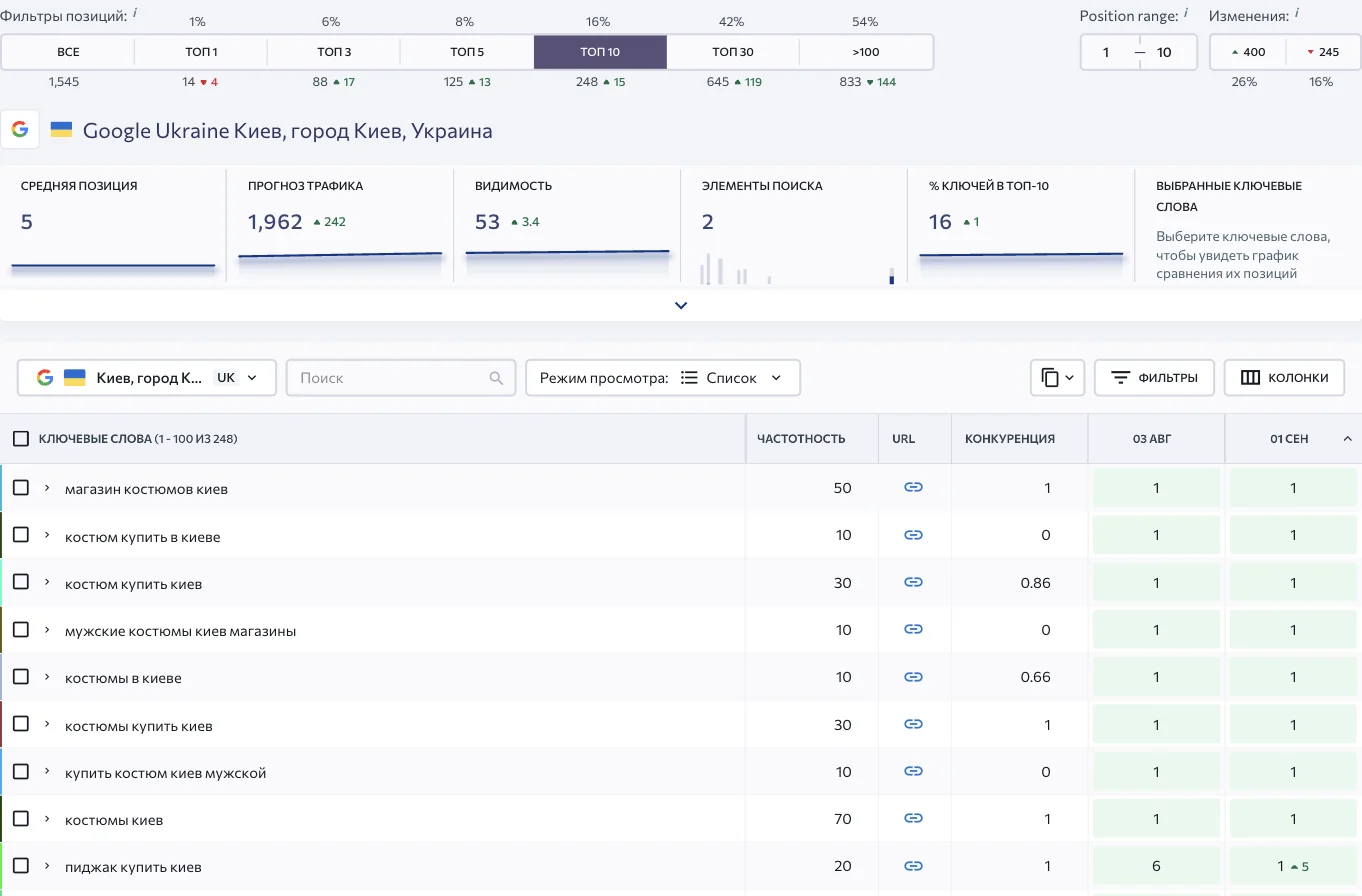
Our own proof comes from Stager, a menswear online store in Kyiv, Ukraine, whose SEO we’ve run since we launched its new website in 2023. According to SE Ranking, as of 1 September 2026, 248 of the 1,545 tracked queries in Google (Kyiv) ranked in the top 10, and 14 of them held first position.
How we approach your SEO budget
Strymba is a studio that designs, builds, and grows websites. Our SEO services start with a free SEO audit. We review technical health, structure, content, indexing, speed, and competitors, then hand over a prioritised plan of fixes.
After that, we work month by month. Ongoing SEO starts from $500 per month. It covers indexing checks, keyword and structure growth, commercial page optimisation, content, internal linking, digital PR, and KPI reporting. We can ship technical fixes ourselves, since development is our core work.
Each month follows the same cycle.
- We record technical health, indexing, demand, and the quality of analytics data.
- We fix whatever blocks crawling, indexing, or the pages themselves.
- We improve landing pages and grow content and internal links.
- We check every change after release and report on results and the next hypotheses.
Online stores have a separate track, ecommerce SEO, built around categories, filters, and product pages. Its price depends on the scope we see after the audit.
SEO pricing questions
How much does an SEO audit cost
At Strymba, the SEO audit is free. You get a prioritised plan of fixes for your developer, editor, and SEO specialist, which you can implement with us or with your own team.
How much does SEO cost for a small business website
We set the scope for a small website after the free audit. If it needs monthly work, that follows our ongoing SEO terms, from $500 per month.
How much does ecommerce SEO cost
It depends on the size of the catalogue, the number of categories and filters, the content volume, and the technical work. We quote the exact figure after the free audit, once we can see the size of the catalogue.
Is it worth paying for SEO
It usually is when search is how your clients look for what you sell and you can commit to at least a year. NP Digital’s data shows the biggest gains in the second year, so a three-month trial rarely shows the full picture.
Is SEO included in website development
The SEO foundation is laid during development: structure, metadata, speed, and indexing. Ongoing SEO is separate work that starts after launch.
Can you stop SEO once you rank
You can scale down to maintenance, which means technical monitoring and updates to your main pages. Competitors keep working on their sites in the meantime, so rankings without upkeep may slip over time.
Next step
Start with a free SEO audit
We’ll show what’s holding your website back in Google and propose a plan of work with a budget.