Service
Ecommerce website development without friction from catalogue to checkout.
Fast filters, modern payments, delivery, ERP exchange, and repeat-purchase journeys.
Buying should feel simple; operations should stay controlled.
Customers should be able to buy in a few clicks, while your team sees orders, stock, and prices in one place. We connect the online store to payments such as Apple Pay and Google Pay, to delivery services such as Nova Poshta, and to data exchange with the 1C accounting system from the start—no manual product transfers and no price mismatches between the website and the warehouse.

Ecommerce website development starts with the buying logic
Building an online store is not just about designing a product page. Shoppers need to find the right item quickly, understand the terms, place an order, and receive accurate notifications. Your team needs to maintain the catalogue, prices, stock, delivery, and marketing scenarios without duplicating data by hand.
In ecommerce website development, we design the path from a category or search to checkout. We account for the range structure, filters, attributes, product variants, payment, delivery, promo codes, repeat purchases, and the integrations you need. For complex catalogues, we check separately how SEO filters, category pages, and product pages will affect indexation and the user experience.

Catalogue, integrations, and control after launch
An ecommerce format is defined by its data and purchase rules, not by the number of products. One project needs a manageable catalogue and online payment; another needs ERP or CRM exchange, logistics services, manager roles, several warehouses, or complex pricing logic. These decisions should be fixed before development starts so that the interface and the back end work as one system.
After launch, your team gets tools to manage content and products, plus a foundation for analytics and SEO growth. We test the key purchase journeys, the mobile version, speed, technical pages, and data transfer so the store is ready for real-world load, not just a presentation. Before the start, compare an online store with a catalog website. For examples, see the Stager, TSP Books, and Würth Ukraine case studies.
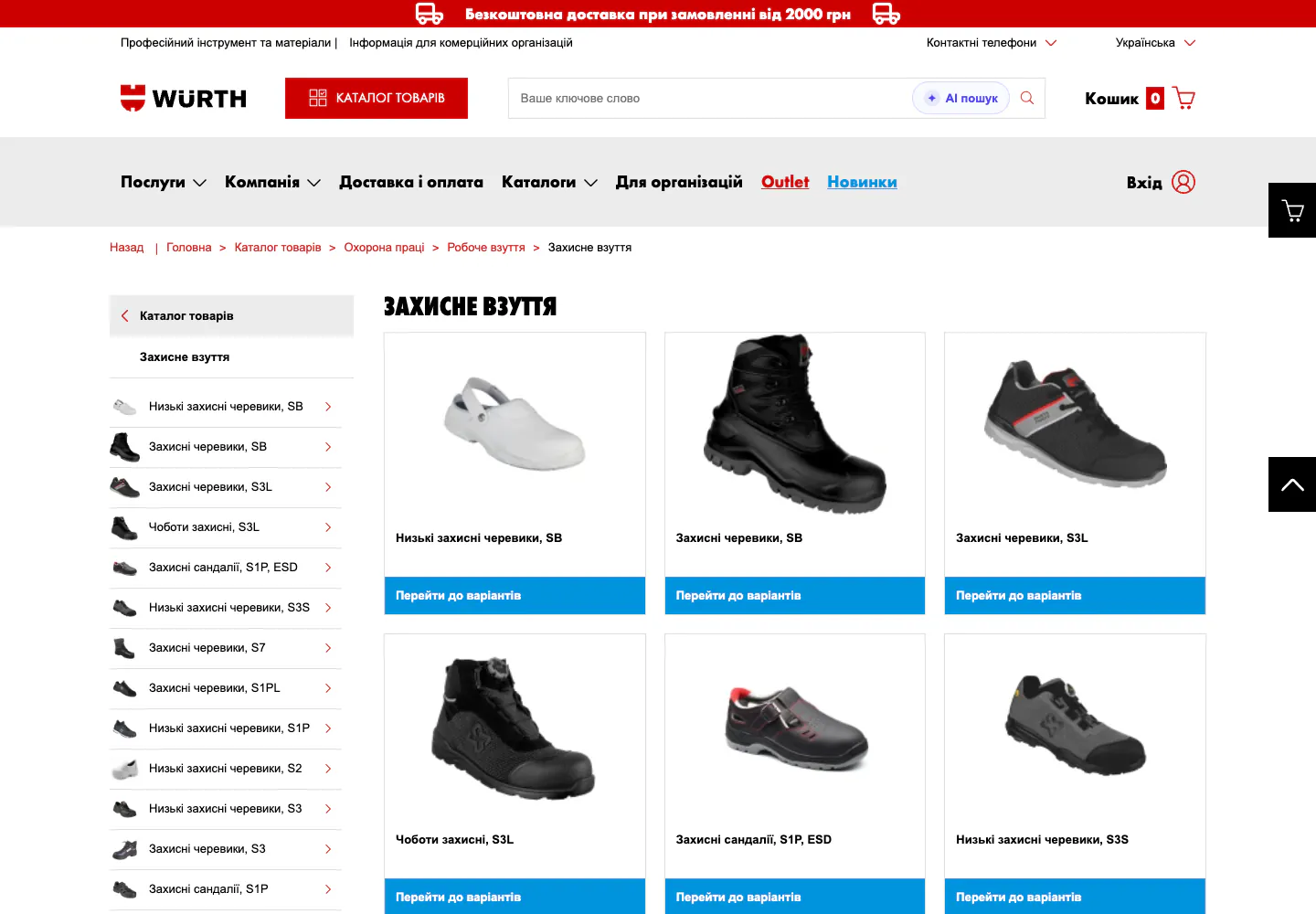
One system from catalogue to checkout
Ecommerce website development cost
Ecommerce website development starts from $2,000. The final price depends on catalogue size, payment and delivery integrations, ERP exchange, and languages. We fix the exact budget after a short brief. Our guide to website costs lists starting prices for every format and explains what drives the budget.
Ecommerce website development FAQ
01What should we prepare before ecommerce website development?
Describe the range, categories, product attributes, variants, prices, stock, and delivery and payment methods. It also helps to know where the data lives today and which processes must not be duplicated by hand. This lets us design a convenient catalogue without a gap between the website, the warehouse, and the operations team.
02Which integrations can an online store have?
At the start, we discuss product and stock accounting systems, CRM or ERP, online payments, delivery, analytics, and email or notification services. Whether each integration is needed depends on how your team works. Describe them before design and development so that the catalogue, checkout, and data exchange work in sync.
03How do you combine SEO filters with a convenient catalogue?
Filters should help shoppers narrow the choice, not generate an endless number of similar pages. Before implementation, we decide which categories and filtered selections have search value and apply technical indexation rules to the rest.
04Who maintains products and content after launch?
Your team can manage product pages, categories, and editorial pages in the CMS, while data rules are aligned with the accounting system. Before launch, it is worth naming the people responsible for the catalogue, prices, stock, and copy—this keeps changes under control.
05How do we order an online store, and where do we start?
Start with a short description of your range, payment and delivery methods, required integrations, and current business processes. In the first conversation, we clarify the goals, audience, and technical constraints, then propose a discovery format, stages, and a realistic development scope.
Next step
Planning an online store?
Tell us about your range, accounting systems, and sales processes. We will suggest a practical launch format.