What is a landing page?
A landing page is a standalone web page built around one offer and one action. Visitors arrive from an ad, an email, social media, or search, and the page leads them to a single step: sending an enquiry, signing up, booking a consultation, or buying.
The name describes where people “land” after they click. A landing page is usually one long page of sections in a deliberate order, each moving the visitor closer to a decision. What defines it is not the number of screens but the focus: one audience, one offer, one action.
Landing page vs website: what is the difference?
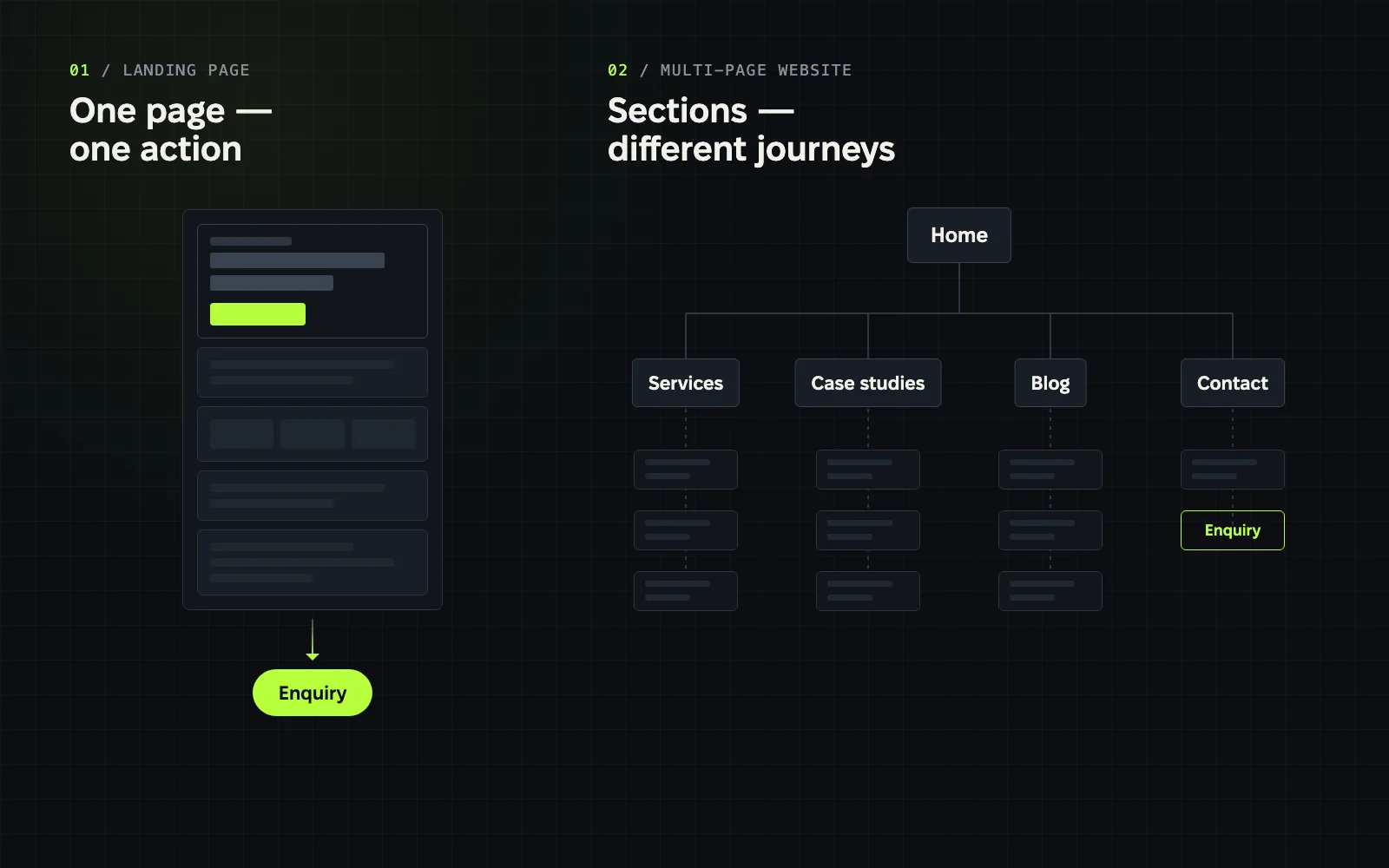
A landing page leads one defined audience to one key action, while a multi-page website presents the whole business: several services, audiences, and journeys. The difference shows everywhere:
- goal—a landing page has one conversion event; on a website, visitors choose between services, case studies, articles, and contacts;
- structure—a landing page is a sequence of sections on one page; a website has sections, navigation, and separate pages for different topics;
- audience—a landing page is written for one segment with a specific need; a website serves several types of visitors;
- traffic—a landing page often continues an ad campaign or an email; a website attracts visitors through many search queries and from different sources;
- evolution—a landing page changes to test how the offer is presented; a website grows with new sections and pages.
So a landing page does not replace a full website—it complements it. A company can have a corporate website and separate landing pages for campaigns or new products.
When a business needs a landing page
A landing page fits when you need to focus on one offer and measure how the audience responds to it. Typical cases:
- a new product or service—the offer needs explaining separately from everything else you sell;
- an ad campaign—the page continues the ad and leads to an enquiry without extra clicks;
- an event—you need to collect sign-ups;
- a demand test—you want to validate a hypothesis before investing in a bigger website or product;
- separate versions for campaigns—one offer is presented to different audiences or for different ads.
If the task is limited to one campaign or one offer, a landing page is enough. What the work involves is described on our landing page design and development page.
When a landing page is the wrong choice
A landing page is the wrong choice when the business needs to present several lines of work, a large range of products, or a tool people use regularly. Another format fits better:
- several services, audiences, or complex expertise—a corporate website with a separate page for each line of work;
- presenting the company as a whole—a small business website, if you need no complex catalogue or integrations;
- selling online—an ecommerce website, or a catalog website when a purchase needs a consultation or a price request;
- users acting regularly inside an account—a web application.
Another common mistake is to fit everything into one landing page: several offers, different audiences, and buttons that lead to different actions. Such a page loses its focus, and visitors find it harder to understand what to do next.
What a landing page consists of
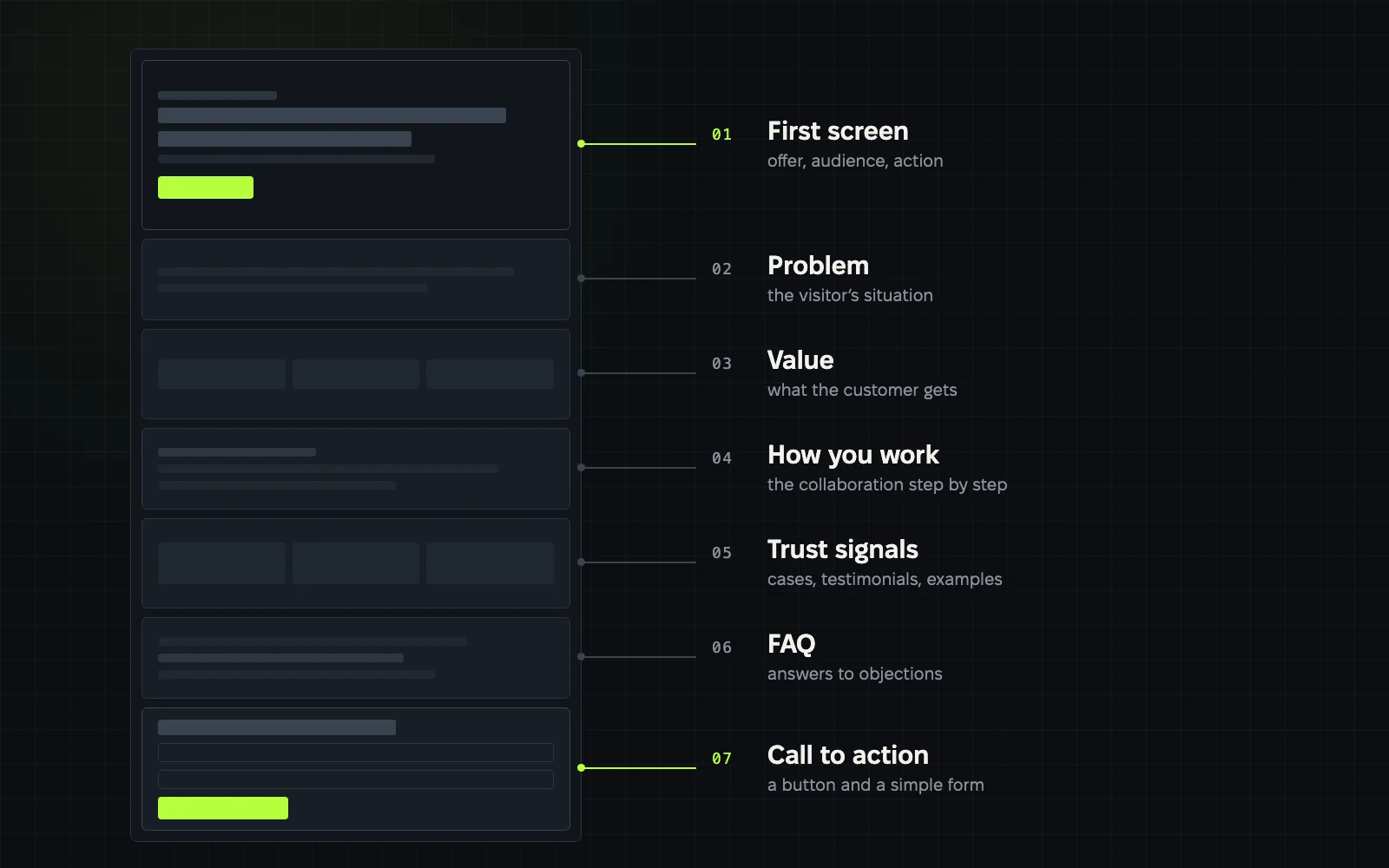
A landing page that works explains the problem, the value of the offer, how you work, the trust signals, and the next step—in that order. An eye-catching first screen is not enough on its own. A typical structure:
- the first screen—what you offer, to whom, and what to do;
- the problem—the visitor’s situation the offer addresses;
- the value—what the customer gets and why it matters to them;
- how you work—how the collaboration or purchase happens and what follows an enquiry;
- trust signals—real case studies, testimonials, or examples of work;
- answers to objections—a FAQ covering the audience’s typical doubts;
- a call to action and a form—a clear button and a simple enquiry form.
The technical side matters just as much: responsive layout, mobile speed, reliable delivery of enquiries into your team’s workflow, essential SEO, and analytics events, so you see not only clicks but also enquiries. Whether to build the page with a website builder, a CMS, or custom code is covered in How to choose the right website platform: 7 criteria.
Landing page examples by industry
The structure of a landing page is the same in any industry; what changes is the main action, the trust signals, and the objections the page has to answer. Here is what to show in common niches:
- logistics and freight—routes and cargo types, lead times, insurance and customs terms; the main action is a quote or a shipment request. The Meest Cargo case study shows how cost calculation, tracking, and a customer account work together;
- real estate agencies and residential developments—the property, floor plans, location and amenities, purchase terms, and booking a viewing. The Sense City case study walks from the first impression to choosing an apartment;
- lawyers and law firms—one practice area instead of a list of every service, the lawyer’s experience, how the first consultation works, and confidentiality. The ADVANQ case study shows how to structure legal services and team expertise;
- accounting services—service packages for sole traders and companies, what each package includes, how documents are handed over, and who is responsible for filings. The Kreston Ukraine case study shows how to present complex consulting expertise;
- cleaning companies—types of cleaning, what drives the price, how quality is checked, and an order form with the date and floor area;
- auto repair shops—services, the car makes you work with, warranty terms, and booking a convenient time;
- beauty salons—services and prices, specialists, photos of work, and online booking.
If the business has several lines of work, do not mix them on one page: a separate landing page for each service or campaign keeps the focus, while the main website presents the company as a whole.

What to decide before design and after launch
A landing page starts with the inputs, not design: where the traffic comes from, the viewing context, what objections the audience has, and which event analytics should measure. If the page runs with ads, the match with the ad, mobile speed, and a clear call to action matter most.
A landing page is not finished at launch: it changes based on data—you test how the offer is presented, the sequence of arguments, form scenarios, or separate versions for campaigns. What the work involves at Strymba is described on our landing page design services page.
How much does a landing page cost?
Landing page development at Strymba starts from $300; the final price depends on the scope of the page. To see how a landing page compares with a small business website, a corporate website, or an online store, read How much does a website cost in 2026?
Landing page FAQ
01What is a landing page in simple terms?
A landing page is a standalone web page built around one offer and one action: an enquiry, a sign-up, a consultation, or a purchase. Visitors usually arrive from an ad, an email, social media, or search, and the sections of the page explain the offer step by step and lead them to that action. Its defining trait is focus: one audience, one offer, one action.
02How is a landing page different from a small business website?
A small business website presents the business as a whole: who you are, what you do, and how to get in touch. It can have several pages and language versions. A landing page is about one offer—a product, a service, an event, or a campaign—and leads one audience to one action. If you need both, the landing page complements the main website.
03Can a landing page rank in Google?
Yes, but a single page answers a limited set of search queries, so landing pages more often work with ads, emails, or social media. The SEO foundation—metadata, heading structure, speed, and indexation—is worth building in during development. If you need to cover many queries, a website with a separate page for each service fits better.
04Can a landing page be changed after launch?
Yes. If the content is managed in a CMS, your team can update the offer, trust signals, FAQ, and button wording without a developer. Agree before launch on what will change most often, so that each marketing iteration does not turn into a technical task. Each change is worth checking in analytics against enquiries and other conversion events, not clicks alone.
05How much does a landing page cost?
Strymba’s starting price for landing page development is $300. It is a lower bound, not a fixed amount: the budget depends on the number of sections and content, design, forms, and analytics setup. We fix the exact amount after a short brief, once the offer, the audience, and the traffic source are clear. For comparison, a small business website or a corporate website starts from $800.
Next step
Planning a landing page for a product or a campaign?
See what landing page development at Strymba includes and where to start: from the offer and the audience to the event worth measuring.