A corporate website is a company’s official website where each line of work has its own page. Visitors use it to check the company’s expertise and contact the right team. This guide is for owners and marketing leads who have outgrown a small business website or a landing page. We explain which pages such a site needs and how it differs from other formats, with examples from three Strymba projects.
What is a corporate website in simple terms
It presents the company as a whole: its services, people, proof, and contacts. In most cases it is a multi-page website with sections, navigation, and a separate page for each topic.
The job defines the format, not the page count. Even an eight-page site can be a corporate one if it covers several lines of work and serves different visitors. A client looks for a service and a price, a partner checks experience, and a job candidate wants to see the team. Each of them should find an answer in a few clicks, without a phone call.
Corporate website vs business website: how the formats differ
Business website is the general term for any site a company runs. Its formats differ in purpose and in how many visitor journeys they support. Among website types by purpose, the corporate one covers the widest range of tasks, so its structure is the largest.
| Format | Purpose | Pages | When to choose |
|---|---|---|---|
| Landing page | one offer and one action | one long page | an ad campaign, a new product, a demand test |
| Small business website | present a company or an expert briefly | home, services, about, contact | one audience and a few services |
| Corporate website | present a company with several lines of work | sections and a page for each service | several services, audiences, or languages |
| Catalog website | show a product range without online payment | categories and product pages | purchases through a consultation or a price request |
Each format has its own page with us. Read what a landing page is, how a small business website works, and when you need a catalog website.
When a business outgrows a small website
It is time to move to a corporate format when one or a few pages no longer answer the questions clients ask before buying. These signs help you spot that moment.
- The company works in several areas, and each needs its own page with a description, process, and price.
- Different people read the site: clients, partners, investors, or job candidates.
- Deals take a long time to close, so you need case studies, a team page, and documents.
- You work with several countries and need the site in more than one language.
- Clients search for you by service names as well as by brand.
If only one or two points apply, a business website can start small and grow later. For a company that matches three or more, a wider structure pays off sooner.
Corporate website structure: which pages you need
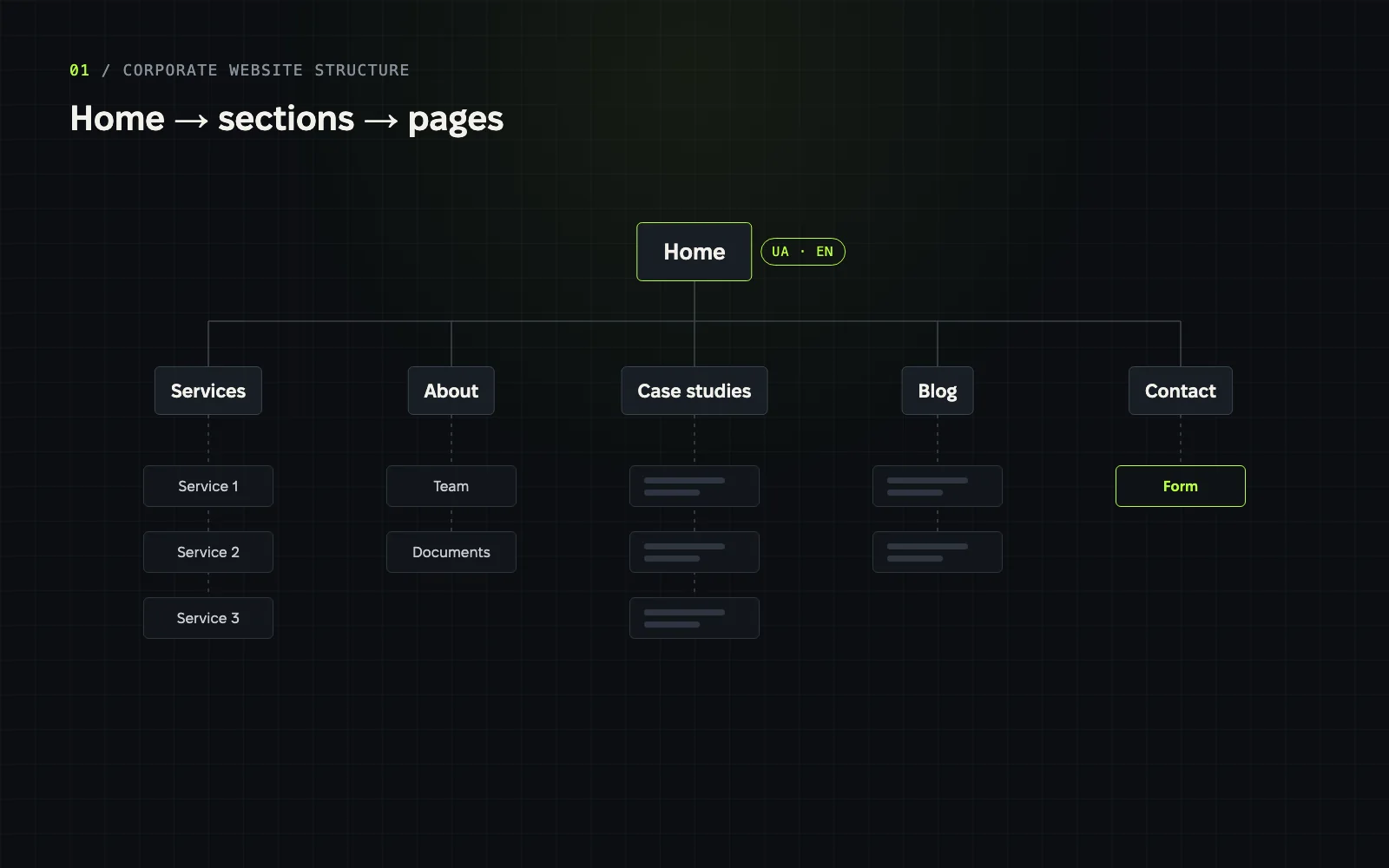
A site like this has a hierarchical structure, where the homepage leads to sections and sections lead to individual pages. Each page answers one visitor question.
- The homepage explains who you are, who you work for, and where to go next.
- A service page covers what the work includes, who it is for, how it runs, and what drives the price.
- The about and team pages show who stands behind the expertise.
- Case studies give proof through the task, the solution, and the result.
- A blog or an insights section answers client questions and brings in search visitors.
- The contact page has a form, an address, and an explanation of what happens after an enquiry.
Depending on the industry, you may add documents and certificates, careers, language versions, or a section for partners. Pages can be short as long as each one has a single topic and links to the next step.
URLs are part of the structure too. Google suggests using words in URLs that are useful to people, so an address like /services/audit/ beats a string of numbers. Settle on section names before launch, because after publication URLs only change with redirects.
Corporate website examples
Three projects from Strymba case studies show how the structure depends on the industry. In all three, what matters most is the route from the visitor’s task to the right service and contact.
Kreston Ukraine: consulting and audit
Kreston Ukraine needed a website that would combine an international brand with a clear presentation of complex consulting services. The information architecture connects client needs, services, people, and knowledge. Visitors move from their task to the relevant service, expertise, or contact. The Kreston Ukraine case study shows how the brand, experts, services, and documents were brought into line.
ADVANQ: a law firm
For the ADVANQ law firm, the website is built around the architecture of its legal services. Contrasting typography and a clear structure help visitors match a business need with the right legal practice. The team’s expertise and the route to a first enquiry were designed as separate parts of the journey, as the ADVANQ case study describes.
Blackshield Capital: an investment company
The Blackshield Capital website was built from Figma designs with custom motion. A flexible content builder and animation controls in the admin panel let the team change pages without a developer. The site is also integrated with Mailchimp. Details are in the Blackshield Capital case study.

What a corporate website needs to work
Beyond the pages, a website needs a technical foundation that visitors only notice when it fails. Without it, even a good structure loses clients and search visibility.
Content management without a developer matters because services, people, and case studies change. It shapes the choice of CMS, which we cover in how to choose a website platform.
Google assesses loading speed, responsiveness, and layout stability with Core Web Vitals, separately for mobile and desktop. web.dev recommends that the main content appears within 2.5 seconds and the page responds to an action within 200 milliseconds. Layout shift should stay at 0.1 or less, and all three thresholds should hold for at least 75% of page loads.
For language versions, Google recommends separate URLs and advises against redirecting visitors to another language automatically. Otherwise people and search engines may not see every version of the site.
Accessibility for people with visual or motor impairments is assessed against WCAG 2.2, a W3C Recommendation. Add analytics that counts form enquiries, plus the SEO basics of metadata, headings, and indexing.
How to prepare
Start with the content and turn to design afterwards. A list of services, audiences, and proof shapes the structure better than any template.
- List your lines of work and, for each, who the client is and what they ask first.
- Gather proof such as case studies, testimonials, certificates, and team photos.
- Decide which languages you need and who on the team will update each section.
- Draft a page map from the diagram above and check it against what clients ask in emails and calls.
With this list in hand, briefing a contractor becomes much easier, and the first conversation goes straight to scope.
How we work on these projects
Strymba is a studio that designs and builds websites for businesses. In a corporate project we combine research, information architecture, UX, responsive design, development, content management, analytics, and technical SEO.
A template website at the lowest price is not what we do, and we do not guarantee sales or Google rankings. Corporate website development at Strymba starts from $800. The final price depends on the number of pages and audiences, the content, integrations, and languages. To compare it with other formats, read how much a website costs.
Common questions
How many pages should a corporate website have
There is no fixed number. Count them from the map above: a homepage, a page per service, about, case studies, and contact. A company with four services ends up with at least eight pages before a blog or language versions.
Can it start small and grow later
Yes, if the platform lets you add sections and the URLs are planned from day one. New services and case studies then appear as new pages, and you avoid rebuilding the site from scratch.
Does it need a blog
Not necessarily. A blog helps when clients keep asking the same questions and you want to answer them publicly and attract search visitors. Without regular posts, a case studies section is enough.
Is an online store a better fit
Only if you sell online, since a store needs a cart, payment, and delivery. A corporate site presents the company and leads to an enquiry. The two can be combined when a company both provides services and sells products.
Next step
Planning a website for a company with several lines of work?
See what corporate website development at Strymba includes, from structure and content to launch.